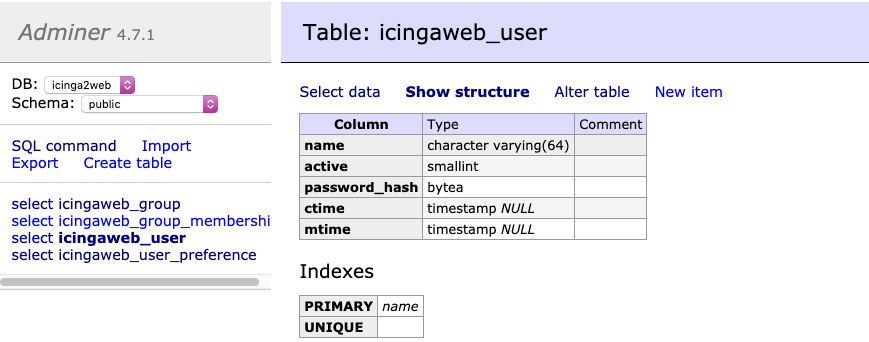
The password hash had being generated with the way described in the docs (native php hash): php -r 'echo password_hash("password", PASSWORD_DEFAULT);'
I have tried two ways of inserting, by just manually inserting the queries and through a seeder/job.
The part of the seeder that is inserting the user: command: ["/bin/sh"] args: ['-c', "psql -h $(PGHOST) -w -U $(PGUSER) -p $(PGPORT) $(PGDATABASE) < /tmp/schema/pgsql.schema.sql; psql -h $(PGHOST) -w -U $(PGUSER) -p $(PGPORT) $(PGDATABASE) -d $(PGDATABASE) -c \"INSERT INTO icingaweb_user (name, active, password_hash) VALUES ('inga_admin', 1, '\\$2y\\$10\\$bG.p6xHqvY1im*****************.**********************')\""]
That was my thought as well, but due to the config shown in the OP. Now that the same name is used in the database it doesn’t matter of course.
@HLA-systeem Which version of Postgres is this? The way Postgres stores bytea values has been changed since v9, which what is expected by Icinga Web 2.
Also, this smells like an encoding problem. Please check whether the hash you’re inserting is really the exact same that ends up in the database. (The hash should start with \x24 if correctly transferred)